



Total Storage Capacity
100 million tonnes of CO2

Maximum Injection Capacity
5 million tonnes of CO2 per year

Startup
within 2030
EU CEF-E Works Funding
55 million EUR





L10-CCS is one of Europe’s most ambitious carbon capture and storage (CCS) initiatives. Located in the Dutch North Sea, the project will permanently store captured CO₂ in depleted gas fields beneath the seabed. With space for almost 100 million tonnes of CO₂, L10-CCS will help reduce emissions from industries like cement and chemicals across the Netherlands and North-West Europe. New offshore facilities are being designed to handle CO₂ safely. These facilities will be operated by Eni Netherlands CCUS. The L10-CCS project is being developed in partnership with ExxonMobil, Tenaz and EBN.
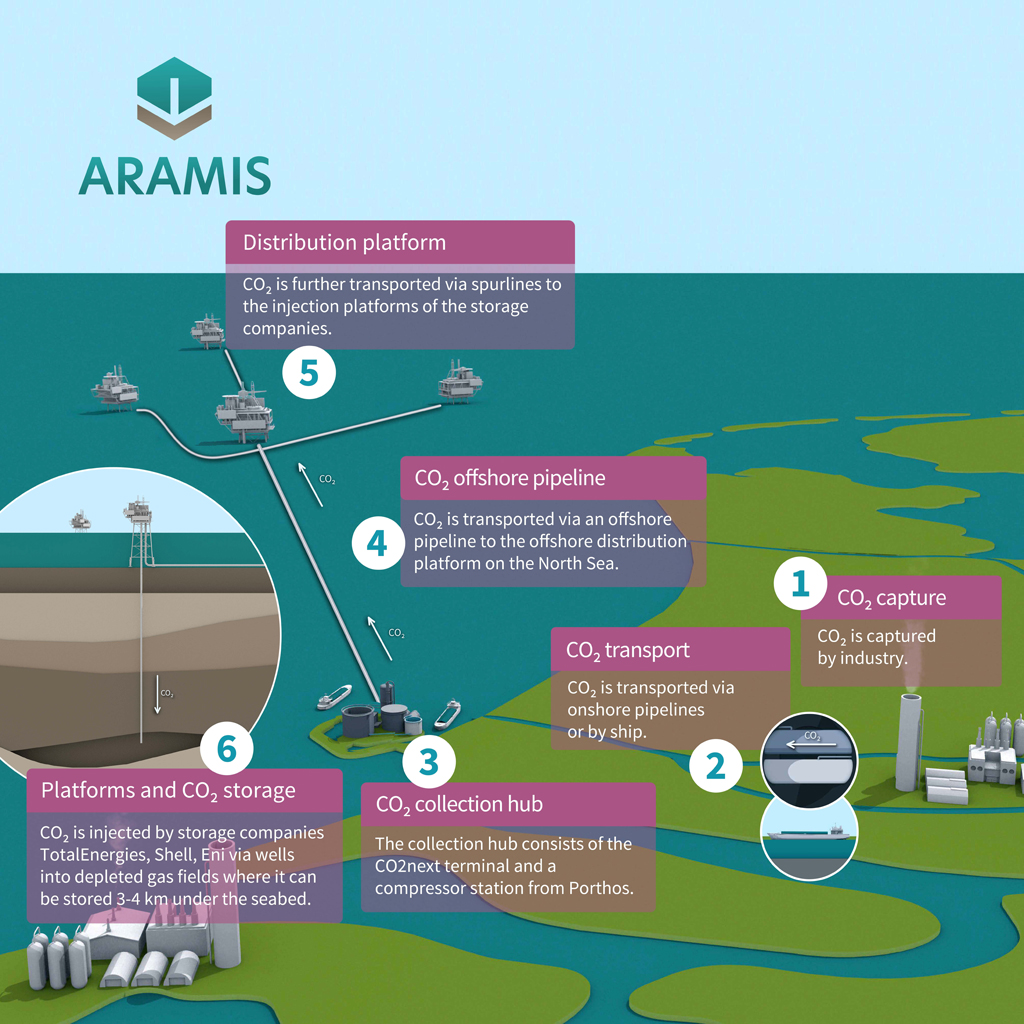
L10-CCS is integrated into the Aramis CO₂ transport and storage initiative. This initiative is designed to bring CO₂ from industrial sources to offshore storage facilities by pipeline and ship. Aramis will follow a phased development approach, scaling up in line with industrial decarbonisation and evolving CO₂ storage demand.
The international and open-access character of the project will support industries in the Netherlands, Germany, Belgium, France, and beyond. It has been recognised as a European net-zero strategic project with a strong aspiration to become an important contributor to Europe’s broader climate ambitions.
L10-CCS plays a catalytic role in shaping the future of carbon capture and storage by integrating within other CO₂ transport networks and infrastructure across Europe. Eni Netherlands CCUS is applying innovative and cost-effective technologies to safely transport, inject, and store CO₂, including the development of a new offshore platform powered by renewable energy. These technologies are designed to ensure that CO₂ is stored permanently and can be replicated in future CCS projects across Europe.
The project will also offer storage capacity for emerging technologies that can remove CO₂ directly from the atmosphere, such as BECCS (Bioenergy with Carbon Capture and Storage) and DACCS (Direct Air Carbon Capture and Storage). These technologies are considered essential for achieving long-term climate neutrality, as they help actively reduce the amount of CO₂ already in the atmosphere. The project supports industrial decarbonisation and strengthens Europe’s position in sustainable energy. Scheduled for first injection in 2030, L10-CCS is an important step toward a resilient, net-zero future.
L10-CCS is an important part of the Aramis CO₂ transport and storage initiative. Fully aligned with the Aramis timeline, L10-CCS is planned to be operational from day one of the transport system’s launch in 2030. The project supports the successful rollout of Aramis and helps unlock large-scale, safe and permanent CO₂ storage for hard-to-abate industries that face limited alternatives for reducing emissions.
The Aramis value chain connects industrial clusters including cement and lime plants, chemical producers, refineries, waste incinerators, and power plants to offshore CO₂ storage via pipelines, shipping and other transport means. CO₂ captured at hubs in the Port of Rotterdam will be transported through a dedicated 200 km offshore pipeline to storage sites in the Dutch North Sea, including L10-CCS.
The CO2next terminal, also part of the Aramis initiative, will receive CO₂ shipments from across the Netherlands and Europe, via barges or the Delta Rhine Corridor, enabling flexible access for emitters located further inland or abroad. Porthos, another key infrastructure and storage project, provides an onshore pipeline connection that links industrial emitters to the Aramis transport system and supports integration with offshore storage facilities.